
Checking Criminal History in Leesburg
Start with the kind of Leesburg record needed. A town police verification confirms a limited set of offense facts. A county court docket shows charges, hearings, and disposition. The Adult Detention Center handles most adult booking and custody questions. Virginia State Police CCRE provides a separate Virginia criminal-history response through its official mailed-form process. These products overlap, but none contains the whole trail.
A practical Leesburg criminal record check follows the event from its source:
- Confirm whether Leesburg Police or another agency created the incident record.
- Ask the Leesburg Police Records Section for the available offense verification and provide precise incident details.
- Search Virginia OCIS under Loudoun and select the court level that handled the charge.
- Use Loudoun County booking channels for adult custody facts created after an arrest.
- Use the VSP SP-167 process for an official Virginia history response when self-review requires the state repository layer.
Keep the incident or case number when one channel supplies it. That identifier makes the next request much easier and reduces same-name confusion.
Request Leesburg Offense Records
The Leesburg Police offense-report page directs eligible requesters to an in-person verification process at 65 Plaza Street NE. The Records Section counter is listed for Monday through Friday, 7:30 a.m. to 4:00 p.m. Call 703-771-6506 or email records@leesburgva.gov when the submission route or an unstated fee needs confirmation.
Leesburg does not publish a general online arrest database through this records channel. Bring enough facts to locate the incident: date and time, location, reporting person, nature of the event, and report or case number if known. Identification and the requester’s relationship may matter. A court order is required when the request seeks the full offense report rather than the narrower verification.
Leesburg Police Records Section
65 Plaza Street NE
Leesburg, VA
703-771-6506
Monday through Friday, 7:30 a.m. to 4:00 p.m.
records@leesburgva.gov
Leesburg Police Department Records
The Leesburg Police Department owns records created by its officers. That point matters because the county seat also contains sheriff, jail, and court offices. A person should not send a town offense request to the Loudoun County Sheriff merely because the event happened in the county. Check the agency name on a summons, verification, or case docket before choosing a records office.
Police files can include the investigative narrative and material that never appears in a court index. Yet Leesburg’s public route is limited. Full offense reports are not released unless court-ordered. The verification confirms selected incident facts instead. Separate items such as photos, body-camera footage, CAD data, or 911 audio should not be assumed to come with a basic verification request. Ask Records whether a distinct request and review process applies.
Leesburg Police did not have a verified dedicated records-lookup app during the research sweep. The official department and verification pages remain the sound starting points.
Leesburg Police Verification Fields
A Leesburg offense verification is narrower than a full report, but it can still anchor the rest of a record search. Published information says the product can confirm the incident date and time, general location, reporting person, and nature of the alleged crime. Those facts help distinguish one event from another and point toward a later Loudoun court file.
Prepare the locator details before visiting Plaza Street. Include the report or case number when known, along with the incident date, time, and location. Provide the requester’s contact information and relationship to the matter. Bring identification. If a full report is needed, bring the court order or ask Records what proof must accompany the request.
- Verification
- A limited confirmation of published incident facts, not the complete police narrative.
- Offense report
- The fuller agency record, which Leesburg says requires a court order for release.
- Case number
- An agency or court identifier that helps the custodian locate the exact event or filing.
Note: Confirm the live counter instructions before travel because the town may change intake methods, fees, or document requirements.
Leesburg Arrests and Bookings
Leesburg Police creates the arrest and incident record when its officer makes the arrest. Adult custody generally moves to Loudoun County’s Adult Detention Center at 42035 Loudoun Center Place. The jail’s record covers intake, custody status, charges or holds, bond information, and release details available through its channels. It does not replace the police narrative or prove guilt.
That split explains why a single Leesburg arrest can require two offices. Ask Leesburg Police about the originating event. Contact the Adult Detention Center at 703-777-0405 for current local custody or booking questions. Then use the Loudoun court docket to see what charge was filed and how the matter moved. The filed charge can differ from the arresting officer’s initial charge after prosecutor and court review.
For a fuller discussion of recent custody, agency requests, and the limits of booking facts, use the Loudoun County arrest lookup. Leesburg does not operate its own jail or public town booking roster.
Route Leesburg Records by Boundary
A Leesburg mailing address does not always mean that Leesburg Police had jurisdiction. Properties outside town limits can carry a Leesburg postal name while receiving Loudoun County Sheriff service. When the agency is unclear, look at the officer, report header, summons, or court docket. Those records name the originating department more reliably than the mailing city.
If Leesburg Police created the event, use Plaza Street for the town verification. If a Loudoun deputy handled it, use the separate Sheriff’s Office Request Center and LCSO rules. Airport and special-jurisdiction incidents can add another layer because the charging agency, not the word “Leesburg,” controls where the police record begins.
This routing step prevents lost time. Town police, the sheriff, and the courts maintain distinct records. A recipient can redirect a request, but a precise agency choice makes it easier to describe an existing record with enough detail for staff to locate it.
Municipal Court Records in Leesburg
Leesburg has no separate municipal criminal court. Town charges route into Virginia’s Loudoun courts. Search the Virginia Judiciary Online Case Information System 2.0 by Loudoun locality rather than searching for a “Leesburg Municipal Court.” General District Court handles misdemeanors, traffic matters, and preliminary felony stages. Circuit Court hears indicted felony cases and district-court appeals. Adult family or household criminal matters can appear in J&DR District Court, while juvenile information is restricted.
The court layer for a Leesburg matter looks like this:
| Court Name | No Leesburg municipal criminal court; use the appropriate Loudoun state court. |
|---|---|
| Case Types Heard | General District handles misdemeanor, traffic, and preliminary felony matters; Circuit handles indicted felonies and appeals; J&DR handles certain adult family matters. |
| Lookup Channel | OCIS 2.0 under Loudoun, followed by the responsible clerk for documents or missing cases. |
| Docket Contents | Case number, defendant, charge, dates, status, disposition, counsel, and available event information. |
| Copies | Ask the specific clerk about inspection, certification, and current fees. |
Leesburg Court Record Coverage
OCIS is an index and status tool, not a download of every document. Circuit participation and online coverage can vary. Older cases, sealed matters, and records outside the public scope may not appear. A person who finds the case number online should contact the listed Loudoun clerk for pleadings, orders, or a certified disposition.
The Virginia Judiciary’s Find a Case explanation shows how statewide online coverage and its limits apply to a Leesburg search.
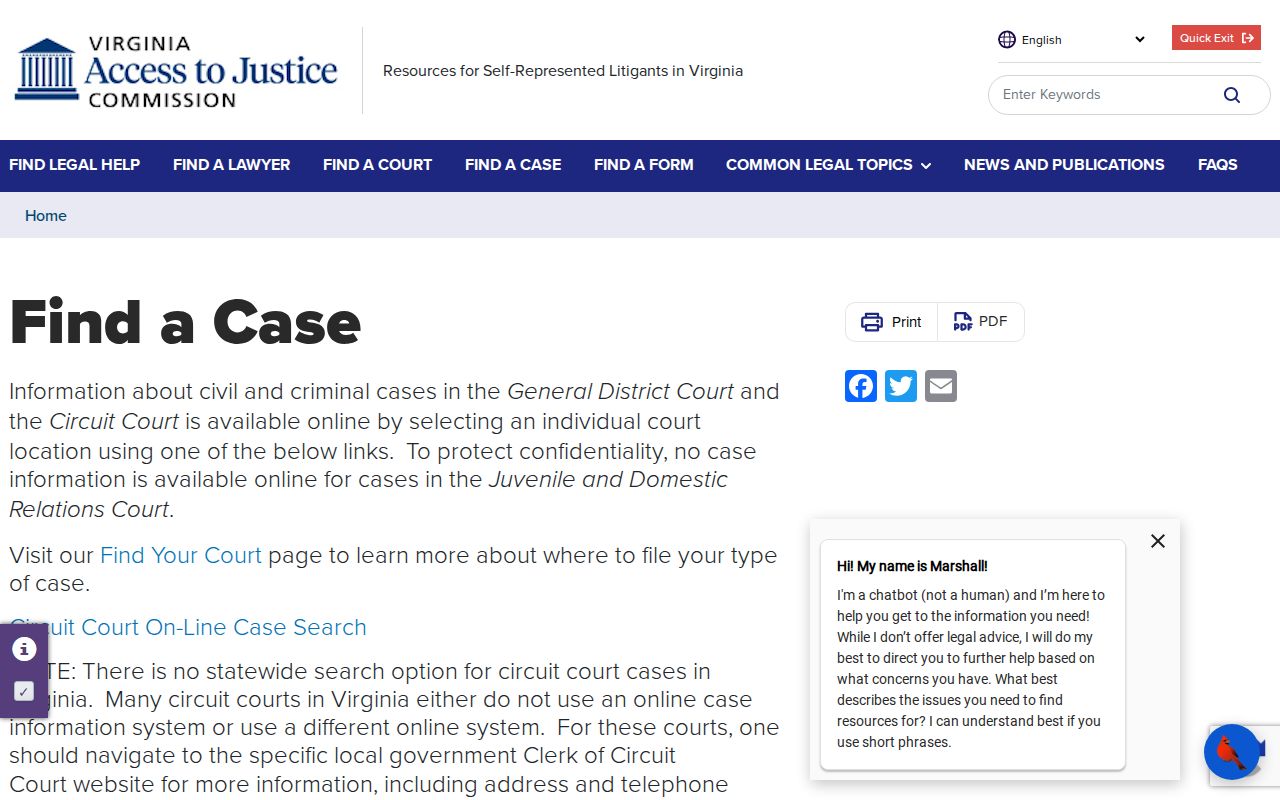
The official guidance supports a two-part method: search the index first, then ask the clerk for the complete public court record.
General District Court is at 2 Church Street NE and can be reached at 703-777-0312. Circuit Court’s clerk is at 18 East Market Street, third floor, with telephone 703-777-0270. Both list clerk hours of 8:00 a.m. to 4:00 p.m. Court-complex screening rules bar camera-equipped phones for most visitors, so ask about authorized copies instead of planning to photograph files.
Where Leesburg Records Go
One Leesburg case can create several official records. Police document the event and arrest. The Adult Detention Center creates a booking and custody entry. A magistrate handles process or the initial bail step. General District Court usually receives misdemeanor cases and the preliminary stage of a felony. An indicted felony proceeds to Circuit Court. Clerks report qualifying dispositions to the state CCRE under Virginia law.
Record flow: Leesburg Police Department › Loudoun County Courts › Virginia State Police CCRE
The booking route runs alongside that court flow rather than replacing it. Recent facts may appear first at the town police or jail level. Filed charges and hearings belong to the court docket. A later CCRE response can consolidate reportable Virginia arrest and disposition cycles. Compare the products when a charge changed, a dismissal appears only in court, or the state record lacks a final disposition.
Note: Correct an error first with the office that created it, then use certified court material when CCRE asks for proof of disposition.
Leesburg J&DR Criminal Records
Adult family or household criminal matters may be heard in Loudoun Juvenile and Domestic Relations District Court even though the court’s name begins with “juvenile.” The court is at 18 East Market Street and can be reached at 703-777-0300. Public online access does not extend to confidential juvenile case information, so do not assume that a missing youth-related result is a database failure.
The official Loudoun J&DR Court page supplies the Leesburg address, clerk information, schedules, and local court context.
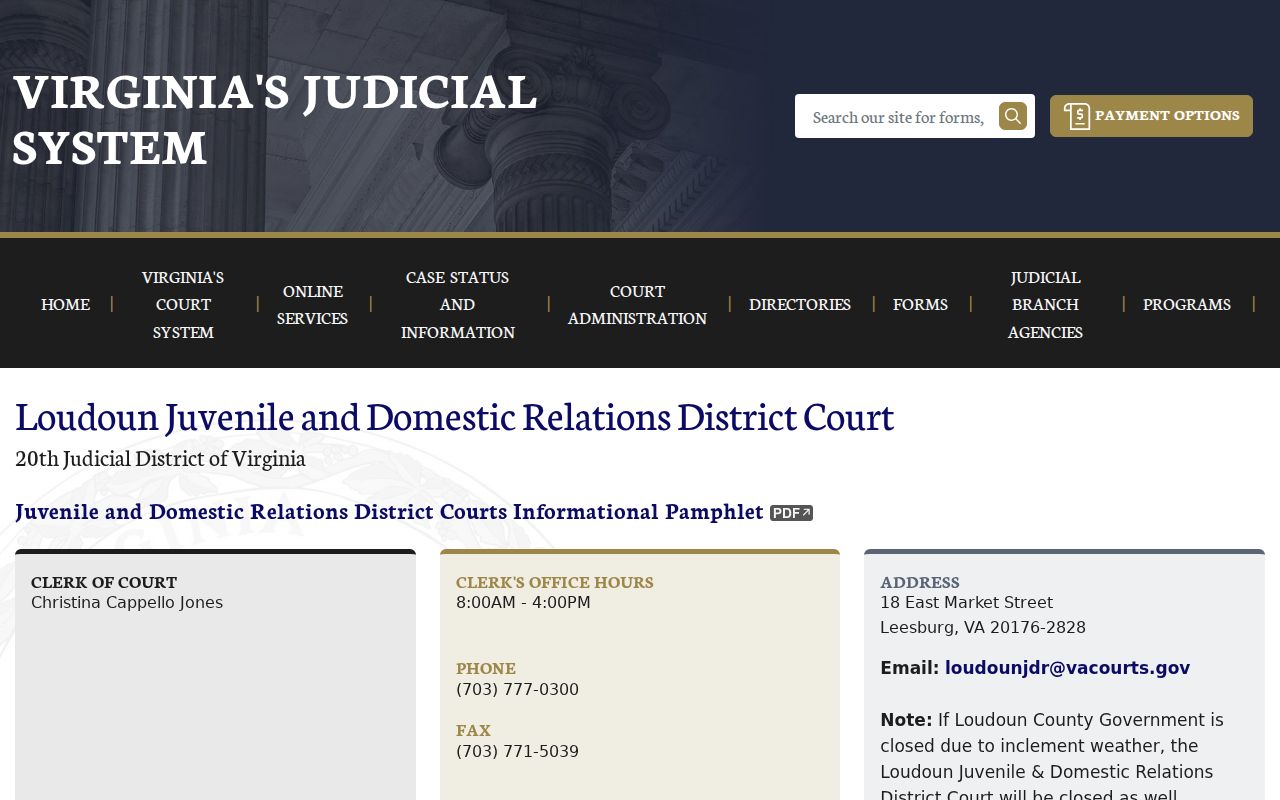
The court page helps route an adult matter correctly while reinforcing that juvenile records follow tighter access rules.
Use OCIS for adult criminal coverage when available. Call the J&DR clerk about a specific public adult file, document copies, or access questions. Do not use the town police verification as a substitute for a court disposition.
Read Leesburg Crime Records Locally
Leesburg Police annual reports are the proper source for town offense and arrest trends. Countywide LCSO totals describe a different service area and should not be substituted for Leesburg figures. When comparing years, keep the same geography and definition. Incidents, offenses, arrests, and clearances are not interchangeable counts.
The annual report can supply context about local calls, enforcement, programs, and trends. It cannot identify the final result of a particular prosecution. Use the case docket for that. A news release is also not a crime-rate series. It highlights selected events and may omit much of the routine record stream.
Leesburg was the county’s largest incorporated town in the research ranking and the county seat. Its independent police records channel therefore sits close to several county justice offices, but proximity does not merge their files. Keep the town statistic, police verification, booking entry, and court disposition in separate columns when researching one event.
Public Access Rules in Leesburg
The Virginia Freedom of Information Act governs many town executive records, but law-enforcement material has special rules and exemptions. Leesburg can withhold or redact protected investigative, victim, juvenile, medical, tactical, and personal details. A public court file follows judiciary and court-record rules rather than the ordinary town FOIA process. Send each request to the custodian that holds the existing record.
Key Statutes:
Virginia Freedom of Information Act sets the Commonwealth’s public-access policy and request framework.
Virginia Code §2.2-3706 provides special access and exemption rules for law-enforcement and criminal records.
Virginia Code §§19.2-389 and 19.2-390 govern criminal-history dissemination and reporting to CCRE.
Describe the agency, date, place, incident number, record type, and preferred format. Ask for a cost estimate when a search or duplication could be large. Leesburg Police’s published offense-report rule still controls the verification-versus-full-report distinction.